📞  — free, 24/7
— free, 24/7 — free, 24/7| Package | Price per Dose | Price | |
|---|---|---|---|
| 360 pills | £0.58 | £243.87 £207.29 Free shipping | |
| 270 pills | £0.67 | £213.08 £181.12 Free shipping | |
| 180 pills | £0.76 | £161.34 £137.14 | |
| 120 pills | £0.87 | £123.16 £104.69 | |
| 90 pills | £0.96 | £102.22 £86.89 | |
| 60 pills | £1.07 | £75.12 £63.85 | |
| 30 pills | £1.22 | £43.10 £36.63 | |
| 360 pills | £0.76 | £323.93 £275.34 Free shipping | |
| 270 pills | £0.87 | £275.90 £234.51 Free shipping | |
| 180 pills | £0.96 | £204.46 £173.79 Free shipping | |
| 120 pills | £1.06 | £149.03 £126.67 | |
| 90 pills | £1.15 | £121.93 £103.64 | |
| 60 pills | £1.26 | £88.67 £75.37 | |
| 30 pills | £1.43 | £50.49 £42.92 |
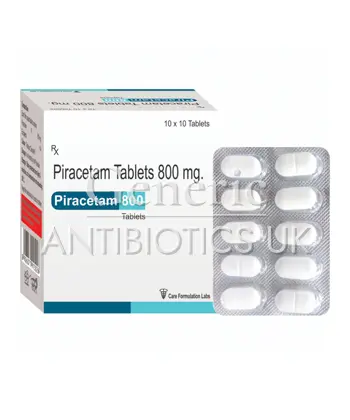
Is Piracetam effective for memory problems related to aging or after a stroke? The medication is used to support cognitive function in selected neurological conditions. It is believed to influence neuronal communication and brain energy processes, and it is often considered as an adjunct to standard care under medical supervision. Clinicians tailor therapy to the individual, with periodic assessment of cognitive and functional outcomes.
Piracetam is a cyclic derivative of glycerol and a member of the racetam class. It is a synthetic nootropic agent with a long history of clinical use in several countries. Pharmacologically, it modulates neuronal membranes and neurotransmitter systems rather than acting on a single receptor.
In practical terms, Piracetam is taken orally as capsules or tablets. Dosing depends on the indication, patient age, and renal function. The agent is generally well tolerated, with most adverse effects being mild and transient.
Primary indications include cognitive impairment associated with aging and various dementias where memory, attention, or processing speed are affected. Piracetam may be used to support recovery after stroke or head injury, and to assist rehabilitation in selected patients with cerebrovascular disease. Efficacy evidence varies by condition and patient factors, and therapy is guided by clinical judgment.
Secondary indications have included myoclonus of cortical origin, vertigo or dizziness attributed to vestibular dysfunction, and certain motor or gait disturbances when cognitive aspects are present. In practice, data for dyslexia or learning disorders are limited and use is region dependent. The substance is usually administered as part of a broader treatment plan and closely monitored for response.
In all cases, regional labeling and clinical guidelines should direct use. Clinicians assess potential benefits against risks and assess functional outcomes such as memory, attention, and daily functioning before continuing therapy.
Piracetam does not bind classic GABA receptors in a clinically meaningful way. It is thought to alter the physical properties of cellular membranes, which can influence receptor function and signaling. It also modulates the release of several neurotransmitters, including acetylcholine and glutamate, to support synaptic transmission.
In addition, Piracetam is believed to enhance neuronal plasticity and cognitive reserve by supporting neurite outgrowth and efficient synaptic signaling. Some studies suggest improved energy metabolism in brain cells and modest enhancement of cerebral microcirculation, which may aid function during aging or injury. Pharmacokinetically, the drug is well absorbed orally and is primarily excreted by the kidneys, with dose adjustments needed in renal impairment.
Piracetam is generally well tolerated in adults. Common adverse effects include headache, anxiety, agitation, insomnia, dizziness, and gastrointestinal upset. These events are typically mild and reversible with dose adjustments or discontinuation.
Serious reactions are rare. Use in pregnancy and lactation is not well studied, and treatment should be avoided unless clearly needed. Renal impairment requires dose adjustment due to renal excretion. Monitor for interactions with other CNS-active drugs and ensure appropriate monitoring of cognitive and functional outcomes.
14–21 days. Free from £150.86 .
5–9 days. £22.63
−10% when paying with cryptocurrency.
−10% on all repeat orders.
All orders are packed in neutral, unbranded boxes with no product name on the outside.